Experimental Guitar Evening

I first met guitarist Craig Green last May when he played on the Livelooping Festival in Cologne that I had organized. Because he is currently in Europe for two gigs in Portugal, he had asked me if we could play together again, so he stopped in Cologne first before going to southern Europe and we did an Experimental Guitar Evening, again at the LOFT, again joined by my Cologne based friend Michael Frank. Each of us did a solo set and at the end, we played two improvisations together. Judging from what I heard from the audience afterwards, it was quite a successful and enjoyable evening.


Michael Frank played a noise improvisation and two of his older compositions: a Gong influenced psychedelic piece, and a wonderful rather intricate piece full of odd meters that although it has no Guitar Craft roots, it would fit in there quite well.

Craig, who came with his amazing new hi-tech Teuffel guitar, played two jazzy, very virtuoso, almost romantic compositions, and one of his trademark noise explorations. I was amazed at his sound, his precise technique, and his style in general. Very inspiring.

My set was not planned out, I was underprepared as usual but also willing to go for the risk. Actually I had vague plans for the beginning of the set that involved walking around in the room, theatrically whirling around my trusty old Höfner Shorty guitar – it has an integrated speaker that screams with string feedback in an amazing way when cranked up, and whirling it around creates a nice man-made leslie effect. Well this part worked as imagined but when I plugged it into my setup, there was nothing. No sound. I did some small talk and actually rebooted my Vista notebook, hoping the sound would reappear – but it didn’t! The audience was very relaxed and humorous, they even seemed to like that something went wrong, and their support made me relax too. Eventually I discovered that I simply had forgotten to pull up my main fader in my new Bidule setup. Argh !!! (sigh)


Anyway, sound was back, and I dropped my vague plans about continuing my explorations of radical noise. Instead I strongly felt like creating harmony, and so I started by setting up a simple but cinematic soundscape, and only later on went through more experiments, noise, samples, and cut-up rhythms.

Here is my 21 minute solo improvisation:


For those who don’t know but wonder – yes, all sounds were played live on the guitar. It can control samplers via midi, so I can play the guitar but you will hear strings, voices, or strange noises. There is even a part where I play a sample of a bee swarm which I had recorded myself last summer.
For those who know this but still wonder: The Fernandez guitar is equipped with a GK-2A and a sustainer. I played through a GT-5, a DL-4, a BitRMan and a Korg Slicer into the Bidule script on the notebook. Faders and switches in Bidule were controlled using a NanoKontrol. Bidule contained a number of VST instrument plugins (the awesome GForce MTron mellotron, a Kontakt sampler, a Humbox voice player), and VST effects such as the KT granular synthesis, the Quikquak Fusion Field reverb, and the beta version of the LoopV plugin for loops and cut-up stuff. Huge thanks to Matthias Grob and Andy Butler for the LoopV – I only used some of its many features but I can say it was stable and I had big fun using it.


Nobody left during the intermission – a good sign I think! The second half consisted of two extended collective improvisations that went very well. A wonderful evening, thanks to the support by the muse, an interested audience, some friends who helped in a generous way, and the folks from LOFT.

Memories of Bathsheba

It has taken 5 years but it was well worth the wait. Gruenrekorder, a German label specialized on field recordings and soundscapes, has just released my new CD „Field Recordings from Barbados“ (please follow the link for more information and sound excerpts). Actually, these recordings had been lying around here for 4 years before I thought of publishing them.


When we went to Barbados in 2004, I took my DAT recorder with me, actually hoping for recording tropical jungle sounds. The island turned out to be somewhat different from what I had expected, but interesting nonetheless in many ways, and I managed to record some soundscapes that the folks from Gruenrekorder found worth listening to.

During our stay, we were glad that we had found Sea-U as our island base camp, a beautiful small hotel belonging to a very nice German woman, Uschi Wetzels. The hotel overlooks the small town Bathsheba that stretches along the wild coastline on the eastern part of the island – the ocean here is too wild to swim, even dangerous, so other than on the ‚platinum‘ west coast, there are not many tourists and the days and nights are quiet. Well relatively quiet – the evening concerts of millions of tree frogs were quite impressive (they can be heard on the CD of course).

We found Barbados incredibly diverse, there were so many things to do … such as … feeding colorful fish with bananas while snorkeling in the coral reefs, walking through a jungle gorge or a tropical botanical garden, visiting a sugar factory, taking a trip with a submarine … but one of my all-time favorite places of this planet remains the Sea-U garden above the Atlantic where I could often be found lying in the hammock, listening to a Jon Hassell record on my headphones.


Of course I took many more photos. Some of them are here

Nineteen Musicians

I was given a very rare and precious treat yesterday, coincidentally, one day after my birthday. The Museum Ludwig in Cologne currently shows a collection of Gerhard Richter’s abstract paintings, about 40 of them, mostly very large ones. Now Gerhard Richter is a big fan of Steve Reich’s music, and because the museum also shows an exhibition about the sixties (beat poets, hippies, minimalism) that contains some Steve Reich material, they thought it would fit in well to book him for a concert.

So yesterday, Steve Reich actually showed up, and was accompanied by the Ensemble Modern.

Their first piece was the first section from Drumming, played by four people (yesterday, one of them was Steve Reich, of course wearing his black baseball cap which is probably permanently adhered to his head) on 8 tuned small drums. They were playing in the hallway of the Museum Ludwig which was crowded with Steve Reich fans (I don’t know if the museum has ever been so full of people), watching the show from everywhere on the same floor, from the floor above, and from the stairways. The performance was stunning, lots of rhythmically difficult phase shiftings, lots of energy, wonderful.


After this short piece we had half an hour to walk around in the museum, and of course, take a look at the huge Richter paintings. This one called „Atem“ (Breath) was the one that I liked most. I have no idea how he does that, technically – the result of his layering and scraping is very three-dimensional but in a slightly unsettling way, my poor little mammal brain was not able to really understand what the eyes saw. I liked that 🙂

Then through a door in the basement into the wonderful Cologne Philharmonie which sits right next to the Museum Ludwig. The main act for this evening was none other than Music For Eighteen Musicians, a piece that is by far my favorite piece of music ever. In the early eighties (I think 1980, but I’m not sure), I saw the European premiere of this piece and I remember that it was almost a religious experience for me – and not only for me, but apparently for many people in the audience. I have never again experienced something like that – being lifted up by that pulsating rhythm, then going through a series of beautiful rhythmic/harmonic variations, and finally landing again. It stills brings tears to my eyes every time I remember the ending of the 1980 premiere – the audience was completely stunned after this trip, there was silence for almost 10 minutes … and then standing up and cheering for a long time … the presence of gratitude was overwhelming.


Yesterday’s performance was very close to that, it was almost perfect technically, good enough to transport the audience to that transcendental place, and back. For some reason I always think of this piece as a giant shimmering spaceship, not unlike the mothership from Close Encounters. It takes us slowly up, goes through these permutations, rotating and twinkling like a huge diamond, and then slowly getting down again after an hour. It is fuelled by the presence of the audience; the musicians are its engine – and they have to be totally present and totally committed to make this happen. This spaceship image was even more appropriate yesterday because the beautiful interior of the Philharmonie seems to have some similarity to the mothership.

What an evening, what a beautiful treat. This time, the silence after the piece lasted not 10 minutes, but only a few seconds – one person started to applaud, and the spell was broken and everyone started clapping and cheering. Maybe people are different today than they were 30 years ago, and also, the piece is a classic today, maybe the largest musical monument of the 20th century (for me it is), and many people know it and it is no longer so surprising.

While listening, I couldn’t help but noticing how my mind stayed in control most of the time, preventing me from being truly moved. Strange that so few music lovers talk about this, it is the most striking thing to me when listening to a concert like this (but maybe many people don’t have such a problem with their heads?) – how difficult it is to get beyond the mind and beyond thinking, analyzing, comparing, commenting, and to really listen with an open heart, and to be really moved. I found myself noticing this, and trying not to stay in the mind, and noticing that of course this doesn’t help.

Fortunately, at least for a while, my mind finally stopped yesterday, and as always when this happens, it happens completely on its own, completely beyond my control. Some sudden change in the music triggers something deep and before my mind can react, it is pushed aside, making room for being moved, being present and still. Then the tears flow, what a relief, I can finally be here without being encaged in my head. This is the „religious“ aspect for me – that this powerful piece of music with its merciless beauty, when executed so well, can stop my head, opening the door to what is real.


Now why is this blog entry called „Nineteen Musicians“? because yesterday, there were 19 musicians playing „Music For 18 Musicians“. Beyond all the stuff that was going on in my head, it was simply wonderful and very interesting to see the musicians at work, to watch how they managed to play these multiple interlocking rhythms, how they exchanged their positions at the various instruments during the various parts of the piece. Seeing this made the structure of the composition much more transparent – I wish there was a DVD showing the making of, maybe looking at the ensemble from an above position. But I bought a DVD showing the Ensemble Modern playing Reich’s City Life – looking forward to that!

Steve Reich, photo credit: Jeffrey Herman

Flashback: Askesis 1992

A couple of days ago, I found an old videotape from January 1992. It contains a short passage where I practice Askesis, a Guitar Craft piece written by Tony Geballe. Tony was Robert Fripp’s assistant on the first Guitar Craft course in Germany, back in 1987 – a week that changed my life. One of the GC pieces I eventually managed to play, mostly together with my GC friend Leander Reininghaus, was Askesis. I loved it for its relentless angularity.

Too bad the final seconds were cut off for some reason on this old tape!


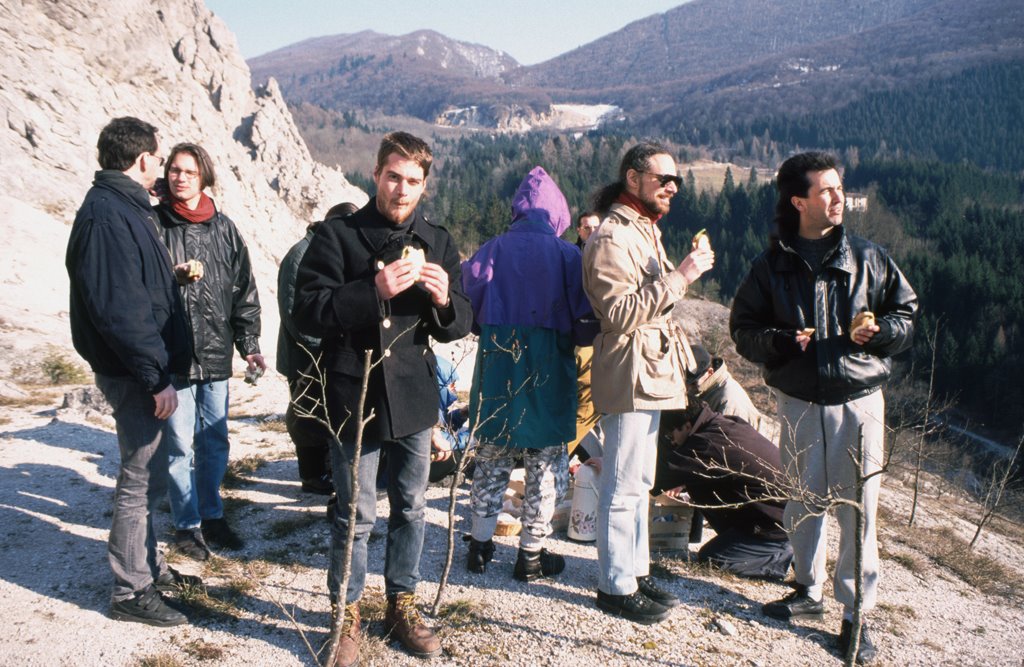
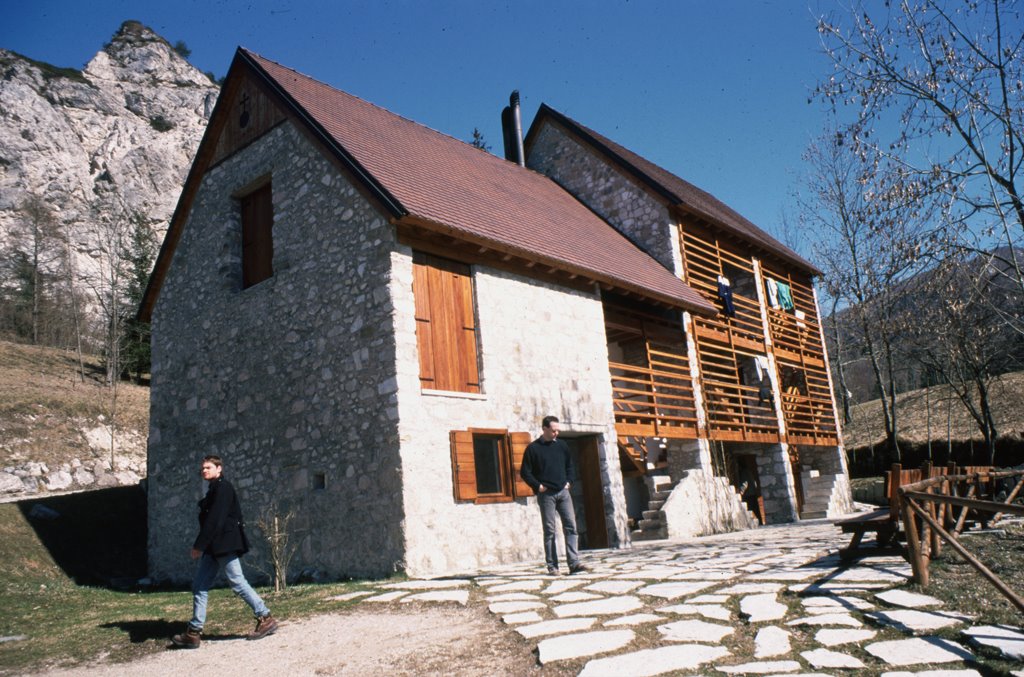
A little bit later, I participated in two GC courses, held in 1995 and 1996 in Andreis, a small place in the Northern Italy mountains, and led by Askesis composer Tony Geballe. Tony is a wonderful teacher. We learned a lot and had big fun – I remember how we stood in a circle, stepped back and forth in fours, and at the same time, clapped in sevens or even more exotic meters.

Shortly after the Andreis courses, Leander, Markus and me formed Trio Gitarristik, a GC/livelooping oriented guitar/Chapman stick trio that stayed together for a year or two – we had a number of gigs, and played Askesis every time.

Paradise is a state of mind

Our latest technological household item is a DVD recorder, several years old and bought used from eBay last weekend. It will eventually replace our crappy VHS tape recorder, and one of the wonderful things it can do is digitize VHS tapes and back them up to DVD.

The first tape to digitize that I grabbed this morning happened to be a 35 minute video from 1982 by Albert Falzon, called „Excerpt from The Kumbha Mela – Same As It Ever Was“. Falzon (who got known many years ago for his surf movie „Crystal Voyager“ with a Pink Floyd soundtrack) went to India in the early eighties to film various religious festivities, one of them being the famous Kumbha Mela, a Hindu festival and possibly the largest religious festival on Earth. This particular video shows part of his travel towards that place: on a boat across the waterways of Kashmir.

For an inhabitant of cold Europe like me, this magical landscape seems very close to paradise. Falzon’s movie is completely filmed in slow motion, and he often uses a fish-eye lens – and there is of course the soundtrack by Harold Budd and Brian Eno. There are no words and there is no action – there is only a lush jungle landscape slowly drifting by, light reflections on water, people moving in slow motion. This stuff seems to come directly from a dream, from a timeless place. (Somehow it adds to the dreaminess that everything is lo-fi and blurry in an oldfashioned kind of way.)

How strange to enter this state of mind, watching this movie, while knowing that Kashmir has been the center and subject of wars for a long time, and is still far from being peaceful on many levels.

If you like the state of mind induced by Budd’s „The Pearl“ or Eno’s „On Land“, you will like this video. Someone has put it on Youtube in the meantime (see below). You can also get it used on VHS tape if you search for it. Apparently it was also rereleased on DVD under the title „Same as it ever was“, together with a movie about the Kumbha Mela festival.


Postcard Weevil

got my postcard weevil today. Big fun !! this is similar to a cracklebox, but with different options … like a mini synthesizer. Handbuilt by its inventor … here is his presentation:

 
I love these things. Why do I love them? And why do other people not love them? My wife and my neighbour looked at me as if I was insane while I played with it. 🙂